
.svg)

.svg)
.svg)
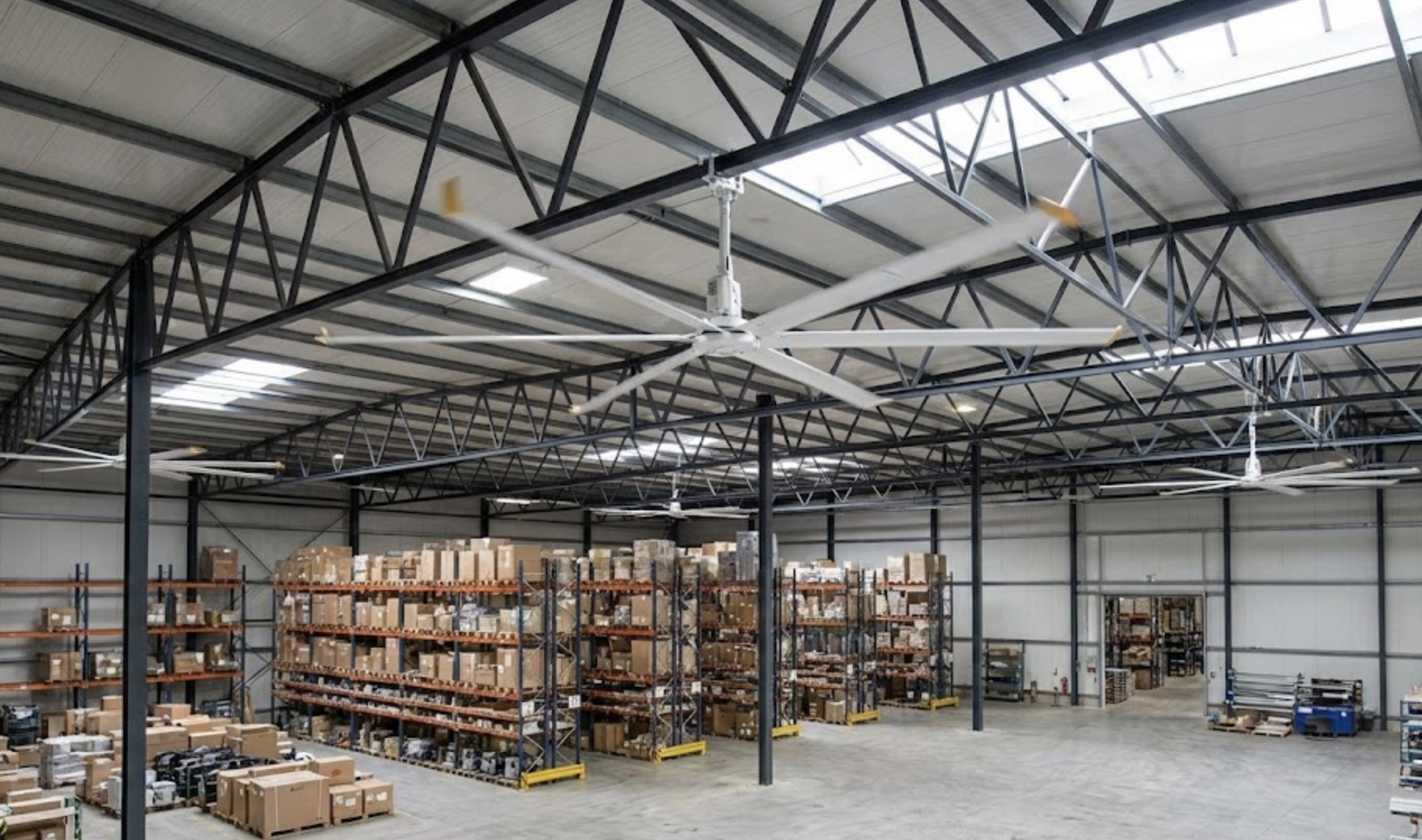
As architectural spaces grow taller, wider, and more open, managing indoor climate becomes increasingly complex. Traditional HVAC systems—designed for low ceilings and enclosed rooms—often struggle to maintain comfort and efficiency in these expansive environments.
From high-ceiling commercial lobbies to warehouse-style retail spaces and multi-level atriums, air movement and thermal balance present unique engineering challenges. Effective cooling in such spaces requires more than capacity—it demands innovation in air distribution design.
Understanding the Challenge of Large-Volume Cooling
Large-volume interiors have greater air mass, higher stratification potential, and more complex thermal interactions between occupants, lighting, and envelope surfaces.
Without precise airflow management, the result is often temperature layering, where warm air accumulates at the ceiling and cool air stagnates below.
This imbalance creates two major issues:
- Energy inefficiency, as systems work harder to stabilise uneven temperatures.
- Occupant discomfort, particularly in areas with fluctuating air velocities or inconsistent cooling.
In these environments, simply increasing system power is ineffective. The key lies in smarter air movement strategies and data-driven system design.
Key Cooling Strategies for Large Volumes
Optima’s engineering approach focuses on airflow precision rather than brute mechanical force. Through computational modelling and advanced system design, we achieve balanced comfort across vast spaces using targeted, efficient airflow techniques.
1. Destratification Fans
High-Volume, Low-Speed (HVLS) fans circulate large amounts of air at minimal speed, redistributing heat trapped near the ceiling.
This restores temperature balance vertically, ensuring comfort at occupant level and reducing energy waste during both heating and cooling seasons.
2. Displacement Ventilation
Instead of forcing cold air from above, displacement systems deliver it gently at floor level.
As air warms and rises, it displaces stale or warm air upwards, creating a continuous cycle of fresh, conditioned airflow.
This method offers excellent air quality, low noise, and high energy efficiency—ideal for auditoriums, retail centres, and offices.
3. Underfloor Air Distribution (UFAD)
UFAD systems supply conditioned air through a raised floor plenum, improving distribution efficiency and offering greater flexibility for layout changes.
This method allows architects to maintain high ceilings free of duct congestion while optimising comfort and acoustics.
4. Computational Fluid Dynamics (CFD) Modelling
Optima’s engineers use CFD simulations to visualise temperature gradients, velocity profiles, and airflow dynamics before construction.
This predictive modelling informs diffuser placement, duct routing, and load balancing to eliminate inefficiencies long before installation begins.
Architectural Integration and Design Collaboration
Successful large-volume cooling depends on early collaboration between architects, builders, and mechanical engineers.
System design must align with architectural intent, ensuring that ducts, grilles, and diffusers integrate seamlessly within the aesthetic framework.
Key integration strategies include:
- Coordinating duct pathways and plant room locations during concept design.
- Selecting diffuser types that complement ceiling patterns or structural elements.
- Minimising visual clutter by concealing ductwork behind architectural features.
- Using acoustically treated materials to maintain quiet operation in open spaces.
By treating air distribution as an architectural element—not an afterthought—designers can achieve both performance and visual integrity.
Sustainability and Performance Outcomes
Energy efficiency is critical when conditioning large air volumes.
Optima’s systems employ variable-speed drives, heat recovery technology, and intelligent controls to match output with occupancy and environmental conditions.
By preventing overcooling and optimising air velocity, these systems can reduce energy consumption by up to 30% compared to conventional constant-speed solutions.
This performance contributes directly to achieving Green Star and NABERS ratings while improving long-term operational sustainability.
Applications Across Sectors
Advanced air distribution plays a vital role in:
- Commercial showrooms and retail environments — maintaining comfort under high lighting loads.
- Public atriums and transport hubs — managing large occupant volumes and variable weather exposure.
- Industrial and logistics facilities — ensuring temperature stability and air quality.
- Educational and cultural spaces — balancing acoustic comfort with cooling efficiency.
Each project requires a tailored solution that considers scale, structure, and occupancy behaviour.
Optima’s Expertise in Large-Volume HVAC Design
Optima’s mechanical engineers specialise in designing and implementing HVAC systems for complex, large-scale environments.
Our process combines performance modelling, architectural collaboration, and precision commissioning to deliver cooling systems that are:
- Technically robust
- Energy-efficient
- Quiet and aesthetically integrated
- Adaptable to seasonal and operational variations
Whether it’s a commercial development, sports facility, or retail flagship, Optima’s air distribution expertise ensures comfort that scales with the architecture.
Engineering Comfort at Scale
The future of large-volume HVAC design lies in innovation, precision, and partnership.
By leveraging airflow science, smart technology, and architectural synergy, buildings can remain cool, efficient, and comfortable—no matter their size or complexity.
To discuss advanced cooling and air distribution strategies for your next large-volume project, contact Optima’s technical team.
We’ll help you design systems that perform beautifully, even in the most challenging environments.